C Section With an Inverted T Incision and Face Presentation
I have procrastinated writing this post. It is the post that I most wanted to write from the moment I my cyber friend Pam dreamed up the idea of writing a blog. I have put it off because I needed to organize my thoughts and my statistics and references and people. Well, really not MY people but the people who are out there that are dealing with having an inverted t incision scar. I feel the pull to get it all down and typed out and saved somewhere that is easily accessible on the internet though so it’s time to stop procrastinating. I just want to make sure that if there is a woman out there googling ‘inverted t incision’ she finds the answers to some of her questions because there is not a lot of information out there. I feel that if I can at least put everything I know in one place maybe someone else will have an easier time than I did when I was trying to learn everything I could.
My quest for inverted t incision knowledge began with my own birth story. In short, we ended up with a cesarean after a very long natural labor that resulted in an inverted t incision because of my son’s face first presentation. So there is no confusion about what the face first presentation is as some people confuse it for ‘face up’ or OP (occiput posterior), I have included some pictures below.The first picture shows what a normal vertex occiput anterior baby looks like in utero. The second picture shows how the baby hyper extends it’s neck when presenting face first. The third shows the different ways the baby can present. My son was Left Mentum Transverse (LMT).
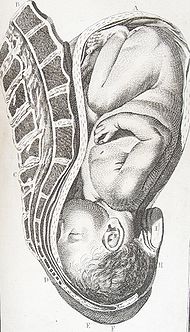
Optimal Fetal Position Occiput Anterior
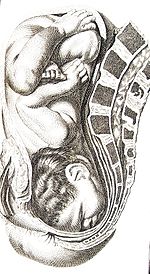
Example of face first in utero, shows hyper extended neck
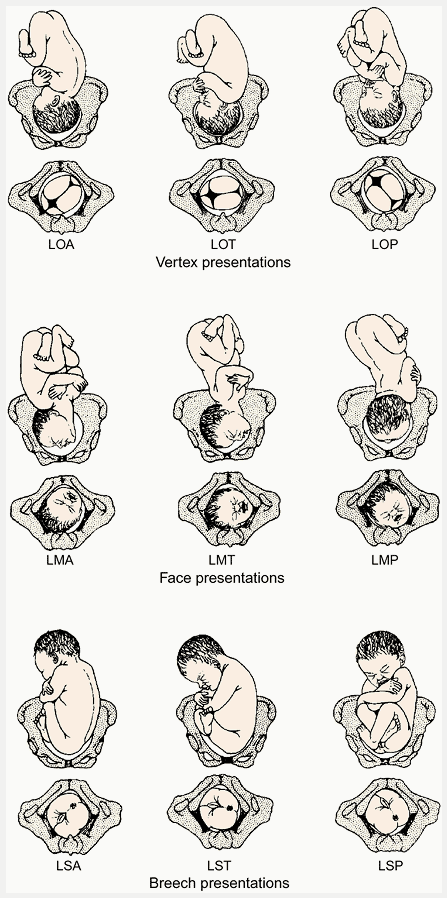
Diagram of fetal positions, my son was LMT
Here is an article written by a woman who delivered a face first presentation. I added it into my article because I am scared that one day the link will not work. The link is HERE. Below is the article…
Face Presentation is a relatively uncommon labor presentation (only about .4 percent of births) when the baby is head down but has its neck extended, as if looking down the birth canal, rather than with its chin tucked into it’s chest. The chin or the nose presents first (very rarely the brow), not the top of the head.
Presentation refers to the part of the baby first entering the pelvic structure on it’s way out the vagina. A vertex birth (head first) happens approximately 95 percent of the time. The options (in order of occurance) are: Vertex, Breech, Shoulder, Face, Brow
Attitude is the relationship of the baby’s extremities -arms, legs and head – to his main body. A fully flexed baby is compact and compared to poorly flexed or extended. A fully flexed vertex presentation makes for the smallest diameter of the baby’s head exiting at all times. If the baby’s head is only partly flexed, a larger diamer will have to come through the birth canal, making for a longer labor and more difficult exit. (Trust me on this!) If the baby’s head is Fully Extended, the baby is Presenting by Face. This sounds very scary when described, as the head is bent backwards till it is resting on the back shoulders. It appears like the baby is going to break it’s neck coming out!
Labor: The top of the baby’s head will be resting (uncomfortably!) on the mother’s backbone. Labor will likely be slower since the face is not an ideal canidate to dilate the cervix. Mom is probably going to be in a bit of extra pain. In my case, once I past transition I had no urge to push since the head was not hitting the proper nerves. (I don’t know if this is always the case or not) I found this very disconserting since I knew from past experience I should be wanting to push. The diamater of the head as it presents is about the same as a vertex birth (abt 9.5 cm). However, while the presenting parts may be equal, for the face presenting baby – the full width of the head is to follow! When a baby is vertex, the head bones actually mold together and overlap, making the head easier to push through and out of the birth canal. Face presentations have no such luck.
Having an angel-faced baby is akin in size to a breech birth!! However, as long as the baby is face up – chin facing the mom’s bellybutton – there is no danger. With a breech birth, the danger is the head getting suck in the birth canal after the body has sucussfully exited, possibly with the cord pinched. With a face first baby, the head comes out first – so there is no danger of asphyxiation.
Please note that angel-faced baby’s are routinely C-sectioned in hospitals. Any baby that is sunny-side up “fits the requirement for a c-section”. Moreover, since labor will be longer and mom will appear to be ‘hung up’ at stages – some will say there is a faliure to progress. (Again, this is simply because the nose does a poor job of dilating the cervix.) Please give labor a try – these babies can and do fit! It’s worth the extra effort.
The Prognosis: Since Angel babies are born sunny-side up (face and throat facing upwards toward the ceiling) the baby needs to be suctioned at once, so no amnioatic fluid is asperiated into the lungs. Since the baby is born with his neck pushing against the mother’s pubic bone, there is sometimes a fear that the child will suffer from breathing difficulties (edema around the throat), but this rarely happens. Although the baby is terribly bruised during the labor (imagine using YOUR nose to force through the birth canal!) the prognosis for mommy and baby (assuming they have a caring provider that allows them to birth vaginally) is fine. The face will be swollen for a day or so. 90 percent of angel-faced baby’s deliver vaginally!!! Mine did! At over 9 1/2 pounds too! With a big ole face like a dinner plate!
If the chin is facing the Mom’s tailbone: (Posterior) Then the prognosis is not so good. Even midwives agree that if you have a face presenting baby with a “mentum posterior”, vaginal delivery is almost impossible. Often the chin will get hooked on the tailbone, and the baby is wedged in the no-mans land of the birth canal. Happily of all face presentations, only about 30 percent are posterior and many of them rotate before they get stuck.
Vaginal Delivery: Remember, 90 percent of all face presentation babiess deliver vaginally!! The reason for this is most face babies aren’t diagonosed until very late in the labor when it is already apparent that baby is coming down that birth canal, doctor training or no! Be aware that if a hospital rountinly uses sonograms during labor, or if your doctor is doing frequent vaginal exams, they will discover your baby is facing the heavens and may request a preemptive c-section (because of the small danger a baby may asphyxiate on it’s own amniotic fluid.) You need to decide what you feel the risks of this are. I had my angel baby vaginally, natrually, and at home. And it’s a decision I feel blessed I made.
Material gathered from: Spiritual Midwifery, by Ina May Gaskin & Gentlebirth
Also some cool midwife books that I don’t own but that my midwife brought over the day after Stealth Baby’s birth to show head position, rotation and generally talk about what happened the night before while I was in labor land.
Most face first presentations are delivered vaginally as they aren’t diagnosed until the baby is descending. In order for a baby to deliver face first, it would need to be mentum (chin) anterior. Face first labors tend to be much more painful for the mom and much slower since faces don’t dilated the cervix very well. Only 0.4% of babies will present face first. In my situation, the doctor didn’t catch that my son was face first and she even tickled his head to stimulate his heart. She must have felt his cheek or forehead. Often times doctors will realize the presentation when they check and the baby sucks their finger. Sometimes the mouth is mistaken for the anus and the baby is misdiagnosed as being breech. The causes of face first presentations can be a weak abdominal wall and the pelvic shape. Other times it’s an OP (occiput posterior) baby who just happens to stick their face in the pelvis at some point during labor.
It has been said that the problem with the face first presentation isn’t really the face but what follows. In our case, my son had a 14.5 inch head that had the face engaged the pelvis would have had to pass through the pelvis unmolded. I am sure that wouldn’t have happened. I do not really believe that women can grow babies they can’t birth but in a situation where a rather large head must birth unmolded, it makes me wonder. Regardless, because his face presented transversely, he was unable to engage past a -3 station anyway. This article discusses face first presentations in more depth.
My face first presentation was diagnosed once the c section began. He was wedged in such a way that he couldn’t go forward and pulling him back out was very difficult as well. This resulted in the additional vertical cut into the contractile portion of the uterus. Interestingly enough, as only 0.4% of babies present face first, only 0.4% of cesareans are inverted t incisions. They are typically saved as a last resort in emergency situations are extremely difficult deliveries that require more room to maneuver within the uterus.
When a cesarean delivery starts out with a horizontal bikini cut as mine did and then is given the additional vertical cut, usually the cut is small and stays in the lower segment of the uterus. These kind of scars are generally considered safe to VBAC although finding a provider may be difficult. My operative report does not indicate how long the vertical cut was, sometimes the doctor does include that information. Mine only says that it was cut into the contractile portion of the uterus. Sometimes the t extension does go into the fundus or the top of the uterus. This is more representative of a classical incision and is considered riskier.
Because of the increased amount of scar tissue and a scar in the contractile muscles, the recommendation from ACOG is that women with inverted t incisions should not TOL (trial of labor) in future pregnancies. My doctor also told me that I should deliver at 36 weeks after an amniocentesis to check for lung maturity. While the third trimester risks of amniocentesis are low
, I have a big problem with purposefully delivering a preterm baby by elective cesarean. My son was born at 41 weeks and 1 day. He was 8lbs and 5 oz. He was healthy other than the birth trauma and breathing issues related to our cesarean. He obviously needed to gestate that long. At 36 weeks, he would have been 5 weeks and a day early. He definitely would not have been ready to be born.
This early delivery recommendation stems from the increased risk of uterine rupture. There is an increased risk but it may not be as high as some doctors make it out to be. The rupture rate for a low horizontal cut (bikini) is about .5% and I have heard doctors say there is a 15% chance of rupture for an inverted t incision (offering no info to back up that claim and not responding when I challenged it). I have read online where doctors say 4-9% but with no references or studies proving that range.
Ann Frye says “.As far as the type of incision goes, the mother who has a low transverse uterine incision is at the lowest risk for scar-related problems such as dehiscence and rupture. Those with classical or T-shaped incisions are at more risk for rupture, which tends to be more traumatic than the usually benign scar disruptions which occur in women with low transverse incisions. While some types of incisions pose more risk, the highest risk is still probably around 5% (some scars are more rare and limited data is available. From looking at the existing data, 5% seems to me a generous estimate of risk for all types of Cesarean scars, with the order of risk as follows: low transverse [0.5% Haq, 1988; to 2% Clark, 1988], low vertical [1.3% Enkin, 1989], classical and inverted T [probably about the same for both: 2.2% to 4%, depending on the study], upright T and J-incision [probably somewhat higher, but no specific data is available].). Women with an upright T, J-shaped, or classical incision or those who have experienced previous uterine rupture may want to birth in the hospital, although finding a practitioner that will assist them to have a VBAC will be more difficult. However, in these cases scar disruption is **most likely** [emphasis the author’s] to occur during pregnancy with accompanying fetal distress and possible death, or not at all. ” The references are vague here as well.
The Landon Study (2004) found that the rate of rupture for inverted t incisions is 1.9%. I tend to trust this study more than anything a doctor tells me or any other study. The reason is because it seems to be the largest one I can find. Most women with inverted t’s do have repeat cesareans so there are not many large studies. This particular study included a total of 17,898 women who had TOL after cesarean. Of these, 14,483 had a prior low transverse incision (bikini cut) and the rupture rate was 0.07%. Of the total 17,898 women who had TOL, 105 had inverted t incisions, j or classical incisions. Two of these women ruptured equaling a 1.9% rupture rate for inverted t, j and classical incisions combined. All of them either showed up late in labor or simply refused repeat cesareans. The outcomes for these two women and their babies were not included in the study.
For me personally,I am comfortable with TOL after inverted t in a supportive environment with fetal monitoring. If I have a successful VBAC, I am comfortable home birthing the next one. I have found a doctor that will TOL with me. His only requirements are venous access (hep lock but I don’t have to have the IV if I don’t want it) and continual electronic fetal monitoring. I can live with both under the circumstances. I will have no time constraints on my labor, limited staff interruption, the use of a tub and wireless portable monitoring, a doula, my Bradley Method trained husband and the comfort of knowing if my uterus blows that my doctor is there waiting in the hallway. There is a 0.095% chance of the baby dying in the event of a uterine rupture. Outcomes are greatly improved when the cesarean can be performed within 20 minutes of the suspected rupture. For me, I can VBAC comfortable knowing these percentages. I think that the option to VBAC for moms with inverted t incisions should be based on the mothers comfort level and knowledge. I hope that this post can help moms make a more educated decision. I will add new information as I learn it.


 Doula Momma
Ooo, the dreaded Inverted T scar. I have one of those too and I did VBAC beautifully! 🙂 My first cesarean was for a brow presentation (they could see her hairline on her forehead). That incision was low transverse. My second cesarean was a scheduled repeat cesarean for breech. My daughter slid transverse during the operation and got stuck. The OB had add a vertical incision to the low transverse that she’d already made. When I got pregnant with my little one, I could not find a VBAC supportive OB, but I did find 2 midwives (DEMs – Direct Entry Midwives) that would assist me at their birth center. If I had lived closer (I was an hour away) they would have assisted me at home. Their birth center was across the street from a fire station with an EMS squad and there was a hospital with a level 1 trauma/NICU about 5 minutes away. Since I was in a birth center I didn’t have a hep lock and the midwife only did intermittent monitoring. We had discussed listening to my body at length before I went into labor. We had agreed that at any time if I felt the need to be at the hospital we would transfer. Luckily, I never felt that need. 🙂
To your readers: If you’ve had an Inverted T, classical or J cesarean incision and are considering a VBAC for your future babies, feel free to join us at Life_After_InvT. 🙂
Jessica
July 2, 2009
Hee hee, I forgot to leave a link for my birth story. 🙂 It’s here!
Jessica
July 2, 2009
Thanks Jessica, I was hoping you would share your story. Like I said in my post, the mother should be able to have VBAC after t incision as an option when she is educated and informed and should birth in a way that is within her comfort zone. I am so glad you were able to find the midwives to attend your birth and to have a transfer plan that you were comfortable with. I have a feeling that many moms that do end up VBACing with inverted t’s are either forced to labor at home as long as possible (unattended) and show up at the hospital ready to push, refusing cesarean or they chose unassisted birth all together. Women should not be forced to make that decision when there is adequate research available.
Thanks for sharing the Life_After_InvT link 🙂
doulamama1
July 2, 2009
Hey Jessica,
I have a comment from a woman who had a brow presentation that went undiagnosed during labor. She had pitocin, an internal monitor attached to the baby’s brow and failed vacuum extraction all of which are no-nos for brow presentations. Care to weigh in on it?
Thanks,
Amy
doulamama1
December 16, 2009
[…] C Section With an Inverted T Incision and Face Presentation […]
Rebirth After Birth Trauma: My Story « Doula Momma
August 2, 2009
Hi my name is Tabitha and nearly 1 yr ago I gave birth to my son but emergency c-section. I had the T-incision and my hubby was told that we should not have anymore as it would put my baby and myself’s life in danger so why are there so many women out there who have had a t-incision ended up having a VBAC after a t-incision or another c-section. Why was I told not to. I really want one more baby and would be crushed if I couldn’t. Your story Jessica was great to read and I hope I can have one more 🙂 i just need stories of women who have successfully went through there full pregnancy after a t-incision.
Tabitha
October 16, 2009
Hi Tabitha,
Thanks for sharing your story. I was personally never told not to have any more and I know of several women who also had inverted t incisions who were not told to have more. I really have never heard of anyone with an inverted t not have more. The typical recommendation is a repeat c section usually from 36-38 weeks. I would get a copy of your surgery report and take it to another doctor and get an opinion. If there is more going on than an inverted t incision then they can help you understand that if you aren’t sure what the report is saying. If it’s the inverted t incision in and of itself, you should be ok to have more children. In addition to Jessica, there are several other women that I know of and have read birth stories of VBACing either with pro-VBAC doctors or midwives. I intend to VBAC next time I have one. I have found both a supportive doctor and midwife so I have some options.
doulamama1
October 16, 2009
If you click on my name in this reply, you will find the page of my website that has more VBAC after Inv T stories. 🙂 It can be done!! Finding the right care provider is crucial. Feel free to join my Life After Inv T Yahoo Group for support and more information. 🙂
Jessica
December 18, 2009
[…] time, she felt eyes. The baby was now in a face first presentation which apparently is pretty rare(https://doulamomma.wordpress.com/2009/07/01/c-section-with-an-inverted-t-incision-and-face-presentati…). The problem was that the baby’s neck was being hyper-extended. Bottom line, the doctor […]
morroni.net » Blog Archive » Ada Elizabeth’s Birth Story
November 4, 2009
[…] (Sunny Side Up), Cervical Swelling and Slow DilationThe Benefit of Breastfeeding ToddlersC Section With an Inverted T Incision and Face PresentationPregnancy Really Isn't 40 WeeksReporting Cytotec Induction to the […]
My Journey to VBAC « Doula Momma
November 19, 2009
*I received this question via email and asked permission to post it and my response here….
Hi! I read your birth story on solaceformothers.org and then I tracked down your email address through your website. I hope you don’t mind.
I had a son in Sept and he was brow presentation. Unfortunately, it wasn’t known until the c-section which was preceded by 22 hours of labor,”torture with pitocin”,as you said, and 2 hours of pushing. My OB too had a really tough time getting my son out of me during the c-section. My little guy is now three months old and has had four nose surgeries so far as a result of the trauma to his face (I am incredibly thankful we are just dealing with nose issues and his back wasn’t broken!). I am trying to deal with the trauma I experienced and I am trying to understand what happened. My question for you – do you know why some facial presentations aren’t known until c-section? My experience was so much like yours in so many ways – I dilated to 6 and stalled and he was very high for a long time. I do know that he was brow presentation fairly early on because they put an internal monitor on, and when he was born you could see that it had been placed on his brow. Is it common to not know that a baby is in a face presentation? Yours was the first birth story I have read with a similar presentation and I find it interesting that your little one’s presentation wasn’t known until the c-section too. I haven’t found too much online about it.
Thanks for sharing your story.
My response…
I don’t mind at all that you emailed. I think that getting answers helps in healing from a birth trauma and it also gives us confidence when we do it again.
Brow presentations occur even less frequently than face first presentations. What I have found says about 1 in 800 for brow, 1 in 500 for face. They are both rare. There are OBs that can go their entire careers without ever seeing one. Mine was the first for my OB. I know a midwife who has attended about 900 births who has only seen one. I think that’s part of why they sometimes are missed, they just don’t suspect it because they’ve never seen it. Another factor is that US OB care does not put a big focus on fetal positioning. Why should they when can just do a c section? I have attended several birth where i hear something like “oh the baby might be OP” (Face up) and then no suggestions are made in how to correct it. Or ‘baby is asynclitic” (head cocked to one side) and again, no help with it. Homebirth and birth center midwives are the opposite. The CAN’T do a c section so they have to do everything else they know which includes getting babies into good positions or they will have to transfer their patient to the hospital.They are MUCH more versed at diagnosing positioning issues and correcting them or facilitating the delivery even if the position stays bad.
Commonly face first presentations are diagnosed when a vaginal exam is done and a nose or eye or mouth is felt. They usually do know when a baby is brow or face. They do a vaginal exam and something just feels funny. My doctor never felt any of that and she even stimulated the baby’s head a few times because of his heart tone issues. My feeling is that with his station being so high (-3) that she really had to reach to feel him and landed on his forehead. He was too high to be able to feel or not feel for fontenels (soft spots) and she never suspected any face presentation at all. You say yours was very high to so I have to assume that’s what was going on as well. Brow presentations are usually diagnosed the same way, vaginal exam revealing a forehead, brow or nose. Brow presentations typically start out as brow presentations at the onset of labor so you are right that he was already in that position. I am so surprised that if they were able to get an internal monitor in that they couldn’t tell that it was a brow. One assumption is inexperience on the docs part. The recommendation for brow presentation is no pitocin, no internal monitoring and no vacuum extraction. You had two of the three so I guess that the OB really did not know but like I said, I am surprised. Have you ordered a copy of your records?
A lot of what I am saying is speculation and assumption. How would we really know the answer? It depends on how much the doc is willing to admit. And then sometimes there really just is no way to know unless and u/s was done but even that can’t be 100%.
I have another inverted t mom friend that had a brow presentation. She might like to weigh in on this as well. Do you mind if I post your question and my response to my blog on the face presentation post? I think it’s good to get the info out in case someone is looking for it. Like you said, it’s hard to find answers to these questions. After i had my son, I couldn’t seem to find anything at all and it was pretty frustrating.
It will get easier with time. I hope your little guy doesn’t have to go through any more surgeries. It will get easier in time, I promise.
Thanks for writing,
Amy
Her response….
I actually had three of the three things that are not recommended for brow presentations – I had the vacuum too – for what seemed like forever. Like I said, I feel so lucky that we are “only”dealing with nasal issues.
Looking back on the delivery there was so much that pointed to something not being right and there was so many factors that I think if they were just a little different the outcome would have been better. My OB was away for the weekend so one of his partners was on call. I would like to think that my normal OB would have taken a little more time with me than the stranger did. In fact the only time I saw the OB that delivered my son during the 22 hours of labor was right at the first when came in, introduced himself, and put the internal monitor in (which another hindsight thing is that two different nurses tried 3 or 4 times to get the internal monitor on and they couldn’t, so the OB rushed in and did it. When my son was born he had several marks on his forehead from them trying to get the internal monitor on and working). After he did that I didn’t see him until I had been pushing for about an hour. And I really don’t think the OB thought anything was wrong until he saw that I was an effective pusher and nothing was happening. Ironically enough I was really wanting a natural drug free birth which obviously didn’t happen but I am sure they let me push longer than a “normal” woman before recommending the c-section. By the time he recommended the c-section I just had a feeling something was wrong and was very much ready for it.
I have not asked for a copy of my records yet. But I plan to after the holidays. I imagine I was the first brow presentation for the OB that delivered and I have a really big suspicion that they are trying to downplay everything surrounding my birth for fear of litigation. I developed two different infections after delivery and was in the OB’s office three times a week for several weeks, not one time did they ask about my son or mention anything about the delivery. At the time I was too sick to even think much about it. Now that I am healthy I am dealing with my experiences though the last thing on my mind is a law suit, I just need to have questions answered so I can understand and heal.
You are so right about the OBs not focusing on fetal positioning! Nothing was mentioned to me except that my son was head down. I thought him being head down and my preparation for a natural child birth would be enough. I have definitely learned a lot throughout this process.
You are welcome to post my question to your blog. Your blog is so informative and helpful. I have spent hours and hours on the internet looking for answers and information and your blog great! Speaking of, I saw that you are expecting on your blog? Good luck with the pregnancy and of course the labor and delivery and all that follows!
Thanks again for the response. It really helps me to read and understand and look forward to another birthing experience more of what I had imagined for this one 🙂
doulamama1
December 16, 2009
Hi reader – my first c-section was for a brow presentation, they could see her hairline and forehead. My doc didn’t use a vacuum or an internal monitor, but I was induced. My daughter’s position was not known until I was fully dilated and nearly ready to push. If the doctor knew your sons presentation at the time he attempted to use the vacuum (and I can’t see how he wouldn’t!) I can’t believe he used it anyways! What a jerk! 😦 Your poor baby, I feel so bad for him. My doctor in his brilliance wanted to try (several times) to turn my daughter’s head WHILE I was having a contraction, he would try to push her head back in while I was pushing. Even at the time in the far away labor land that I was in that just seemed like the most retarded idea I’d ever heard. I couldn’t figure out why they didn’t turn the pit down or off and have me get on my hands and knees and put my shoulders to the bed. I’ve always thought they should have let me do that to try to see if she would come down out of the birth canal so we could try to line her up better. I’d already had an epidural but it failed and there were plenty of people in the room that could have helped. Ugh, I obviously still have some unresolved issues there too.
You are not alone! The good news is that even though my 2nd was a brow presentation, my 3rd and 4th were not. The other good news is that a brow presentation is the sign of an ample pelvis, takes more room for a baby to get wedged in a brow (with the widest part of the head across the birth canal) than to push a baby out that is properly vertex or breech. The draw back is that means there is more room for your baby to get into some whacky positions. I highly recommend chiropractic to make sure your pelvis is aligned properly and red raspberry leaf tea to keep the uterine muscles toned.
Good luck!!
Jessica
December 18, 2009
Thanks for the response. Did your daughter have any injuries from her birth? I sure hope not and I am very glad you had two more deliveries that weren’t brow presentation!
I don’t know why the doctor didn’t realize he was brow until the c-section. Or if he did, he sure didn’t mention it to me. After I had pushed for almost 2 hours and he had used the vacuum for what seemed like a long time he finally said “I am afraid to use the vacuum anymore because I don’t want to hurt him, he isn’t coming out for a reason” but he didn’t say what that reason was – and I was totally in exhausted labor land and didn’t ask, assuming he didn’t know.
I do have a big pelvis 🙂 I am 6 foot tall and my husband is 6’6. I think one of the reasons that brow presentation wasn’t susepected when I was stalling and when he wasn’t budging while pushing was because the nurses and doctors kept saying what a “big baby” he was. I think they were thinking he was stuck because of his size or some BS like that. I didn’t then and still don’t believe that I would have a baby bigger than my body could handle, so I blew it off and pushed extra hard trying to shut them up. BTW – my HUGE baby was 9 lbs 3 ozs and 23 inches long. Not a small one, but not a 14 lber or anything lol.
I find it interesting you suggested making sure my pelvis is alligned correctly – I know my hips are not alligned right and I have done physical therapy to try to fix them. I never thought of how that might have played a roll. I did drink rasberry leaf tea throughout the 2nd half of my pregnancy, though it is probably a good idea to keep it up.
Thanks again for the response 🙂
Erin
December 18, 2009
My daughter didn’t have any injuries like your son, mostly just chiropractic stuff. Have you ever gotten a copy of your labor and surgical report from the hospital? It would say in there if the doctor noticed the brow presentation before surgery.
You are absolutely right!! Unless there is something very wrong with your baby, your body will NOT grow a baby you can’t birth. Docs just like to use that as a scare tactic – usually on short women like me – to get them to consent to a c-section easier.
I would definitely do more work on your pelvis to make sure it is aligned right, if it’s not it can cause your babies to be in all sorts of wonky presentations. Drinking RRL tea between pregnancies is just as helpful too, maybe moreso. 🙂
You are very welcome!! 🙂
Jessica
December 18, 2009
Erin, I went to a chiropractor about 6 weeks ago for the first time since I am pregnant again and I had a previous malpresentation. After the exam I learned that my pelvis was so misaligned that one leg was 3/4 an inch longer than the other and that it also had a posterior tilt. I had sciatic nerve pain, lower back pain and the chiro showed me three spots where nerves were being pinched. I don’t know when all this happened or if it was during my last pregnacy or what but I’d be willing to bet that I did have some misalignment that cause the face first presentation. I just finished intensive therapy going three times a week for adjustment. Now I’ll go twice a week for a month or two then I’ll go once a week or every other week for the rest of my pregnancy.
Jessica, I didn’t know a roomy pelvis can cause a brow presentation. I know that face firsts are often caused by weak abdominal walls but I can’t wrap my head around it. I am not Ms Fitness but I have moderately exercised my whole life. I am within a healthy BMI and I am a chronic suck inner (I don’t like my pooch to hang 😉 So I can’t imagine that my abdominal wall is that weak. Face presentations are also associated with fetal abnormalities and the majority of them do have some kind of problem, Graham was fine. I do worry about having a repeat this time but I figure mathmatically the chances are nearly impossible and with everything I am doing (optimal fetal postitioning techniques, chiro, prenatal massage, prenatal acupuncture) surely I can prevent it.
doulamama1
December 18, 2009
We apparently responded at the same time. I was going to ask you if you are doing RRLT. I have been a little wary to do anything herbal or otherwise with my scar. I think for me that when I envision a natural labor I mean completely natural.
doulamama1
December 18, 2009
Amy – I would be more willing to blame a roomy pelvis on a brow presentation than weak abs. 😦 I’ve never heard that one and would be interested to hear the logic as it doesn’t make sense to me either. I had been exercising before my brow presentation so, even though I’d had one baby, my abs were in pretty good shape too. Glad to hear you are getting chiro care – it can make a world of difference!
I know what you mean about having a natural labor, however I don’t look at it that way. You aren’t going to be drinking massive amounts to induce contractions, just drinking small amounts to tone the uterus. You do kegel exercises to strengthen your pelvic floor, you walk to exercise your legs and cardio system. Other than orgasms there isn’t any way to exercise the uterus to tone it, RRLT will tone it. If you start drinking it and find that it does give you contractions then back off, water it down, stop drinking it, whatever you feel is necessary, but really I don’t look at it as an intervention when used in this way. I was also wary of doing many things because of my scar too, but I did also take EPO orally from 36ish weeks on with Thalea. No idea if it helped or not since I wasn’t using a large dose like what I see discussed in certain forums on the internet.
Jessica
December 18, 2009
Jessica,
You got me curious as to all the different suspected reasons for brow presentations. Most references are saying they are the same reasons as face…
http://emedicine.medscape.com/article/262404-overview
“Brow presentation is the least common of all fetal presentations. Incidence varies from 1 in 500 deliveries to 1 in 3543 deliveries. Early in labor, a brow presentation may be encountered, but this is often unstable, and it converts to a vertex presentation. Occasionally, extension may result in a face presentation. The causes of a persistent brow presentation are generally similar to those causing a face presentation. These include cephalopelvic disproportion or pelvic contracture and increasing parity and prematurity, which are implicated in more than 60% of cases of persistent brow presentation. Premature rupture of membranes preceded brow presentation in as many as 27% of cases.”
http://knol.google.com/k/malpresentations-q-a#Brow_presentation
“What are the commonest causes of face presentation ?
An increase in the tone of extensor muscles of the baby’s neck.
What are the causes of brow presentation ?
Same as those of face presentation”
http://www.gfmer.ch/Obstetrics_simplified/face_presentation.htm
“Primary face:
It is less common.
It occurs during pregnancy.
It is usually due to foetal causes which may be:
Anencephaly: due to absence of the bony vault of the skull and the scalp while the facial portion is normal.
Loops of the cord around the neck.
Tumours of the foetal neck e.g. congenital goitre.
Hypertonicity of the extensor muscles of the neck.
Dolicocephaly: long antero-posterior diameter of the head, so as the breadth is less than 4/5 of the length.
Dead or premature foetus.
Idiopathic.
Secondary face:
It is more common.
It occurs during labour.
It may be due to:
Contracted pelvis particularly flat pelvis which allows descent of the bitemporal but not the biparietal diameter leads to extension of the head.
Pendulous abdomen or marked lateral obliquity of the uterus.
Further deflexion of brow or occipito – posterior positions.
Other causes of malpresentations as polyhydramnios and placenta praevia.”
There were several other references basically repeating what I posted above. There is almost enough variation in the ‘reasons’ that it makes me think that it is really unknown as to what causes these positions in the absence of an obvious fetal deformity or issue. What say ye?
doulamama1
December 18, 2009
Oh yeah and the RRLT, I hear you. I can see where it is not as much of an intervention. Ollie had suggested i use a uterine toner that she forumlated and it ahd cohoshes and EPO and I decided that it wasn’t for me that the cohoshes were an intervention and not one that I am willing to accept. I’ll have to think about the RRLT though. I have visions of the internal contraction monitor in Graham’s labor telling me my contractions weren’t strong enough when in reality my uterus was just giving out after about 48 hours. Plus I think my body knew the baby couldn’t take anymore. Proof of that was that pitocin couldn’t even make me have stronger ctx. Still, it leaves a strong image and I do want nice strong working contractions next time.
doulamama1
December 18, 2009
Those are fascinating, but I think you are right, they have no idea. lol My brow presentation doesn’t fit into any of those categories. She was only my 2nd, so it’s not like I was even multiparous yet. The only thing that I can think of is PROM. Although, I have no way of knowing what the tone was of her extensor muscles then.
Oh and all of my kids have had their cords wrapped around their necks and various other body parts many times, so I think we can agree that reason is crap.
Oh jeez, I know which uterine toner you are talking about, I don’t like that one either. Here is something for you to alter your visions with – Internal Contraction Monitors are not accurate, pitocin can cause unorganized and ineffective contractions in some people and you had every right to be tired. Take the pit out of the picture and things will be so different for you next time. 🙂
Jessica
December 18, 2009
I just want to THANK everyone for the *hope* that is present here. I am crying as I write this b/c my son is four years old – it has been FOUR YEARS and my birth experience is NO less traumatic than it was then – and now that we’re in the now-or-never window for having “one more” I’m facing realities and hard decisions that I’ve put off because the grief was too much. I couldn’t even imagine going through another birth. I’ll try to summarize – but like others here, I was shooting for a 100% natural birth – I’d done my research, had a detailed birth plan, hypno-birthed through a looooooooong labor and though I thought I would literally DIE from the pain – had I had another birth prior, I might have known something was WRONG – but I hadn’t, so I didn’t. During pushing, the OB suddenly yelled “STOP PUSHING – THAT’S NOT A HEAD!” From all-natural to unconscious – I didn’t even MEET my son until many other people had – had touched him, spoken to him – I was – literally – devastated. He was very stuck due to the long labor and pushing and they had to make the cross incision to get him out – he also had “breech legs” – where their little knees snap up to their chest/always bent – for weeks. I felt – quite literally – like the VICTIM of a horrible crime – primarily b/c this hospital does not even ATTEMPT vaginal breech births – AND an ultrasound was done long into my labor which was incorrectly read – assuming his bottom was his head/down low. I was so DESPERATE not to have anything else taken from us – so aware that some women leave hospitals with NO babies – that I cocooned myself – my baby NEVER left the room without us – my husband NEVER left the hospital. Now…for the first time I’m reading about a VBAC even being POSSIBLE with a T incision – I’m always so “researched”, but this was so hard for me – that until I had to, I wasn’t looking further. I’ll be 40 this October – we really are in the “now or never” stage – I may be crying – and I STILL don’t know where to put my anger that noone that should have said “I’m sorry” – only people that had thought my labor was heroic, but had no part in the responsibility – nurses on the floor. I don’t know how to move forward – but it was SO GOOD in all of the darkness to have on little light shone. THANK YOU ALL SO MUCH FOR SHARING YOUR STORIES.
Kimrose
March 25, 2010
Kimrose – First, many, many hugs to you! I totally understand your reaction to that birth experience. I am so sorry that your baby was in a bad presentation. I do know how to feel about the 40 being “now or never” stage, I’m there. I had told my husband that I wanted one more and it had to be before I turned 40. I’m heading toward my 2nd VBAC after Inv T. Feel free to email me personally, I’m sure Amy is available too. Talk, vent, cry, do whatever you need to do. Have you gotten a copy of your records? When you are ready, you may find it helpful. Also, the length of time since your son’s birth is a good thing for your scar’s healing time and strength. 🙂
More hugs again!
Just an FYI too, I’ve changed the name of the Yahoo Group from Life After InvT to Special Scars ~ Special Women.
Jessica
March 25, 2010
In my abs defense, I would like to say that I was in pretty darn good shape too 🙂 I have always worked out and worked out my entire pregnancy. Other than the large pelvix, I don’t think my brow presentation fit the descriptions. I agree, I don’t think they know what causes brow presentations. But having the weird allingment in hips seems to make sense to me biologically to play a roll. Hopefully the work you are doing with the chiropracter will help out with presentation and your comfort in general!
We found out that our son is going to have to have more surgeries. The work the ENT surgeon has done so far collasped. Unfortunetly this is the absolute first case of something like this that the surgeon knows of. He has searched the literature and talked to other hospitals. Lucky us! We are basically buying time until he is older and then they will “rebuid” his nose. For now they are just trying to keep it open. I think I should do a Public Service Announcement on head down is not enough.
Erin
December 20, 2009
Well I am glad you had tight abs and it still happened (not that I am glad it happened of course) because one of my fears has been that I haven’t exercised enough and mine are too weak going into this pregnancy predisposing me for another face first. I mean, I KNOW that it unlikely but still the thought has crossed my mind anyway. I believe my case is a misalignment issues especially after seeing the diagram of my skeletal system at the chiro. I was CROOKED.
I am so sorry to hear your poor baby has to have more surgery.
And I cannot tell you how much I preach that head down is not enough. And you would not believe how surprised my clients are when they hear it. MOst respond with “oh my doc said the baby’s in a great position, head down!” blehghg
doulamama1
December 20, 2009
I can almost guarantee that both of your abs are better than mine were before my last pregnancy and before my current. lol This is my 5th, I don’t have abs anymore. rofl
Erin – I’m so sorry about your son’s nose. I’m not usually a litigious type – but have you considered consulting an atty? That is just ridiculous! 😦
As I move forward in my midwifery education and practice I, too, will keep in mind that head down is not enough. 🙂
Jessica
December 20, 2009
Lol Jessica, like you will have to keep it in mind 😉
I am with you, not usually one to jump the ‘sue the doc’ gun but this does sound like true malpractice. I would be really curious to see what her charts say. I just cannot fathom not catching a brow after three or four pokes by an internal monitor. Considering everything she has told us I don’t see how he didn’t catch it. And it pisses me off to no end that all three of us had pitocin when pit is a big time no no for face/brow presentations. Why in the hell are these docs so quick to up the pit when obviously something is wrong? Don’t you think that common sense would tell you that if the baby is not descending that there is probably a pretty darn good reason for it, let’s find out WHY before we start trying to force what is not going to happen anyway? Screw protocol, every mom and baby and birth are different, if a baby isn’t coming out easily there is probably a reason, FIND OUT. ok thanks. 😉
doulamama1
December 20, 2009
Erin,
I was wondering how your baby was doing? I hope things have been going better for you and for him!
Amy
doulamama1
February 24, 2010
Hi, it has been a while, but I wanted to provide an update to my son…
His nose holes are still very small and he has now been seen by a Pediatric Plastic Surgeon that says he will need more surgeries in the future. He doesn’t go back to the plastic surgeon until next summer.
I pulled my medical records from the hospital and……the OB did not MENTION that my son was brow presentation. He said that he was vertex and I had a c-section for failure to progress. Which is an out and out lie. First of all, my son was brow presentation and has 4 surgeries to show for it (and more to come). Second, I progressed to 10 cm and pushed for 2 hours.
Luckily the NICU, lactaction consultants, and pediatric ENT did document things correctly and explained why my son was injured the way he was.
I am sure that the doctor thought by not mentioning the brow presentation he might avoid any trouble – as I had three things documented that are contraindicated for brow. Whatever the case I am so mad about the medical records I could spit fire. I am mad for so many reasons – first that my son has had a really rough first year, and according to my OB records everything in L&D went absolutely “normal”. There is no indication as to why my son suffered the injuries he did, and that just makes me irate. Second, because we want to try for #2 and without proper and complete medical records, well I am worried about getting practitioners to sign off on a TOL for VBAC.
We are meeting with a lawyer in two weeks to determine what our next step is going to be. One thing is for sure – I WILL have my medical records corrected to be a reflection of what happened to me and my son.
Erin
November 6, 2010
Thanks for the comments and support. I have had several people suggest I persue malpractice. I blew it off at first because I just wanted to get through this and put it behind us. We have “good” insurance so I was just going to eat the money. My interest and desire for a natural birth has made it evident that doctors are c-section happy because of the lawsuits and I didn’t want to add to that culture. But as I have done more research I truly believe it is malpractice and if wasn’t for the pit, vaccuum, and internal monitor I wouldn’t be nearly as apt to go the legal route. And unfortunetly the news we got from the doctor on Thursday leads up to believe we are going to have long term problems including having his nose rebuilt when he is older. So it really is more of a finanicial burden than we are able to deal with. On top of that, I am just pissed off now. I am with you – I stalled out for HOURS. Why was the only thing they did was pour more pitocin? I knew at the time it wasn’t a good thing, but they gave me a 24 hour time limit to have the baby vaginally before an automatic c-section so they were giving me tons of pitocin to try to fit my labor in that window. It is RIDICULOUS. The entire thing. I live in an area where this is the norm, the c-section rate is ridiculous. While I was pregnant I contemplated driving two hours to have a midwife and birth at a hospital that held more of my ideals but I decided against it because I thought I would do all the work, labor at home for the majority of the time, and then just show up at the hospital for the doctor to catch the baby. Didn’t turn out that way obviously as my water broke before I was having much contractions so we were directed to go on to the hospital. I have a lot of guilt for not listening to my instincts and going to different practioners but I am working through it.
As always thanks for your responses. You don’t know how much it means to me to type this out and get some objective views.
BTW – I sure didn’t have a 6 pack or anything, but I was really active and considered myself physically fit 🙂 After several months of recovery I can tell my abs need some work!!!
Erin
December 21, 2009
Thank you for the article. The surgeon had to do a j-incision to remove my son as the umbilical cord was wrapped around his neck twice and he was not coming out. I never even considered VBAC as I was told in the delivery room that it would not be possible. My son was only 5lbs 9oz at 38 weeks. The thought of having this baby at 36 or 37 weeks really frightens me.
Marisol
January 6, 2010
The Landon study lumped classicals, Inv Ts and Js all together, in the end the risk of rupture was only 1.9%. I can understand not being comfortable attempting a VBAC after a J incision, but please know that it is possible. Finding a care provider that is willing to assist you might be tricky, but there are a few OBs and home birth midwives around that will assist you. I put a link to my yahoo group in the first reply to this post. The name is Life After InvT, but it’s for anyone who’s had a classical, Inv T or J incision. Please feel free to join us or to email me privately for more info about friendly providers. 🙂
Jessica
January 6, 2010
Okay, I found this site and felt incredible relief!! I had an inverted T (small vertical cut) I had thought a VBAC was impossible! How did you find a doc that would TOL with you? What did your insurance Co say?? Can I email you or anyone on this board for any more info?!
I AM SO EXCITED!!
Sarah
May 11, 2010
Sarah,
My situation is unique since I’m in Korea. Korean’s typically do not VBAC at all but there are a few VBAC friendly docs around .My doc, who is quite seasoned, agreed to do it. He’s a big believer in natural birth being the best option and attends homebirths and breech vaginals and VBACs in the hospital. He believes that the safest VBACs are the ones that are the most undisturbed. I got lucky, in short. I gave you some tips on the other comment you left but if you want to email me my email is amyncarter at msn dot com or you can also email Jessica (above). You can also join the Life After Inverted T yahoo group or our Special Scars Special Women’s Facebook page for more information.
doulamama1
May 14, 2010
Can you recommend where to start looking for a doctor that will do a backflip after a classical?
Caroline
September 14, 2016
Oh My God, I FINALLY found a site with other womens stories who have experienced a t-incision during cesearian! why has it been so hard to find? I was pretty emotional after reading the stories, party becasue I now have a little bit more hope & because I finally found other women who have walked in the same shoes as myself.. my birth story is, oh, I’d say a definite (I’m a poker dealer, so) “Bad Beat” 🙂 people at work laugh when I tell them my son gave me a “run for my momney” but he sure did. In a nutshell, my pregnancy was prety much this, placenta previa which led to hemorrage, massive clotting,(they say caused by placental abruptions.. the bleeding/clotting/abrubting put me into early labor at 27 weeks pregnant, they (THANK GOD) were able to stabilize me & stop my contracions with a “nifedapine” which I then had to continue to take every day, every six hours, for the next 61days that I spent on my back in the high risk maternity unit. my son was shceduled for a cesarian delivery at 36weeks(because they were afraid of more abruptions/bleeding), during the surgery my son decided that he wanted to creep up sideways into my chest(what felt like my throat), meanwhile the placenta was delivered 1st(they actually had to cut through the placenta to get to him because it was in the way, so needless to say, they were frantically trying to get to him to get him out! Anyway, they had to cut a T-incision,& within a few seconds he was out.. he wasnt breathing at 1st, but right as they were yelling “ressesitate” he started screaming & crying.. (thank you lord).. I, too, was “advised” to not carry any more children & to look into surrogacy.. at 1st I definitely considered it, after all that I had gone through. Now HERE is where it gets a little more complicated, AFTER the delivery I thought I was healing well, then 6 weeks later I started bleeding BAD, they gave me the usual run around, “oh, its just your period coming back, its normal…” yada, yada, yada. I told them it wasnt normal at all & that I was bleeding tons of huge clots, they tried putting me on ALL KINDS of hormones & birth control to control it, & well WEEKS later they decided that I either needed a hysterectomy OR a procedure called a “UAE” uterine artery embolization. Its where they actually go into your main artery, find the vessels that transfer blood to the uterus & sort of “plug them up” to stop the bleeding. This procedure is NORMALLY ALWAYS & ONLY done on women who have Fibroids, the point of the procedure is to pretty much “Starve” the fibroids of blood so that they die off.. I DIDNT have fibroids but they made me feel like this was my last resort before a hysterectomy! Finally after the procedure was unsuccessful they decided to tell me that I could have a “D&C” done.. UH, WHY wasnt this ever offered to me 1st? This was my 1st experience hemoraging, I was Clueless to my options & desperate for help, so I trusted them to do the right things in the correct order. A Polyp was found & removed during the D&C & I completely stopped bleeding. I cant express in words how upset I am that a D&C wasnt done right away. I Later found out(after the doctors originally told me that it would have no effect) that a “UAE” can cause, oh no, I forgot the exact name, but pretty much its where when you get pregnant, & your child has a high chance of not recieving an adequate amount of blood?(because my blood flow was lessened to my uterus)… uggghhh! so not only was I “considering” surrogacy because the dr.s told me that I had a really high chance of complete abruption on my next pregnancy(because of the T-incision & previous previa & abruption) BUT Now, I’m terrified to get pregnant because I would never risk my child not getting anough blood? I’m soo confused. Had I not had the UAE I’m about 99% sure that I would have tried to carry my next child. My son is 17months old & I already desperately want a second child. I dont want to have to do surrogacy(my sisier in law said she’d carry it), but I really just want to have my own. I had so much hope reading all of your stories that I could do it(get pregnant w/my 2nd child), I definitely would have chosen another c-section, & early maybe 36-38 weeks, thats never been a concern of mine, my concern is, do I chance it? will I have placenta previa again? & a few small abruptions/clotting again? will that then lead to a complete abruption? Will my baby get enough blood?? I’m soo confused.. I just dont know what to do or whats right?
Thanks, Katrina, 29 years old…
katrina
August 6, 2010
Hi katrina,
I’m sorry it took me so long to get back to you. I just had my second baby so I’ve been a little busy! Wow, you have quite a story! We have an inverted T group on Facebook if you are on there, you should look us up, it’s called Special Scars~Special Women. I am not familiar with the risks of UAE. I know it’s ok to carry a baby after an inverted T and to even VBAC one, as I just did it but the UAE stuff is unfamiliar. I hope you are able to get some answers though and that you can have another baby.
Amy
doulamama1
August 13, 2010
Hi my name is Amy,
I had teo T incisions while having my daughter my c-section. Does anyone know any information about having two?? i would love more children, and am very worried about what having teo T incisions may mean for me? i have them one on top of the other back to back.
amy
August 12, 2010
i meant to type TWO T incisions sorry! i had two T incisions for the one birth! any info, advice etc please contact me! x
amy
August 12, 2010
Hi Amy,
I’m Amy too 🙂 I’m just confused. How do yo have two inverted T incision in one birth?? I just had my second baby. My first was my inverted T baby and I just had a VBAC with my second one so I know it’s possible. We have a group on Facebook for women with different scars, it’s called Special Scars~Special Women, if you’d like to join us. Someone may have some insight for you.
Good luck!
Amy
doulamama1
August 13, 2010
Thank-you for your post. It gave me food for thought!
Lori
November 7, 2010
My girlfriend just lost a full term baby to a ruptured T-scar uterus. She has a lot of questions that her doctor is not answering. Due to her being Old Order Amish, she doesn’t have access to the internet. If possible, I’d like to ask you more specific questions on her behalf.
cindyln@live.com
violetscrossing
January 1, 2011
Thank you so much for this article. A VERY dear friend of mine had a cesarean with her first birth due to a brow presentation after an attempted homebirth. She was DYING to have a normal home birth and ended up having a prolapsed cord at 28 weeks with a inverted T c-section. I’m glad to hear about the Landon studay and it’s even sweeter because her first son’s name is Landon! 😀 So it’s like it was meant for her! I know this whole thing has been very hard for her, so I’m hoping this article gives her some comfort! Thank you for sharing!!
Krista
December 9, 2010
ive had 4 csections. i have an inverted t incision also. i would luv to have a 5th child but drs have discouraged and scared me too. im glad to see ur post with some very less frightening statistics
misty valentine
February 7, 2012
Misty – have you checked out the Special Scars ~ Special Women website (http://www.specialscars.org)? Lots more info there. 🙂 I have had 2 VBACs since my Inverted T. We have 2 women in our group who have had a VBAC after 3 c-sections including an Inverted T.
Jessica
February 8, 2012
I feel relieved that am not the only one who had my son be born by the face presentation but am also very much heartbroken because my son suffered prenatal asyphxia and now he has cp
Grace muange
February 11, 2012
Thank you for your research!!! I have a classical incision and while my uterus was on my belly my doctor took my mom and husband to my belly, pointed out the classical incision, and said, “She can NEVER labor again.” I have been trying to research what my classical incision means for future VBACs and encouraged my your notes and your research!!! Thank you for your time and effort!
Erin McDowell
February 29, 2012
I normally would agree with you, on paper your arguement is compelling. I had a VBAC and am lucky to be alive today. Both myself and my son almost died. Thirteen years later, we both suffer the consequences of that decision daily. While success rates seem reasonable,I can attest that when everything goes wrong….a cesarean does not seem so bad 🙂
Patti
July 30, 2012
Hi My name is Amy. I’m now 22 weeks pregnant with my second child. My first born was via a J-incision. My waters had broken with meconium staining so it was deciede to induce me “hard and fast” as I was not dilated at all. I don’t know what would have happened if I had gone into labout naturally, but after over 2 and a half hours of pushing whith no progress. (I could see the probe cord moving when I pushed but as soon as I stopped pushing it got sucked back up. The OB took a look and said that baby was facing the wrong way (not sure which way though) and tried to manually turn him. Unfortunatly he truned back with the next contraction. I was then given an emergency C-section which started with a bikini cut. However we found the reason for the no progress was that I had a single large contraction which didn’t relax (I had an epidural so I had no idea. Normally with a C-section they take the baby out once the uterus relaxes, however since mine didn’t (even after then giving me 2 doses of nitroglycerine as a muscle relaxant) the ended up doing a J-Cut.baby was fine except for being jaundice due to bruising from the trauma and he had to be under UV lights for over a week before we could go home. I was told at the time and in a follow up visit to the OB that there shoudln’t be any problems with pregnancy in the future but they would strongly reccomend an elective C-section at 37-38 weeks. (He aslo mentioned that he had been unable to make a fist for a week following my operation because his hand was so bruised!. Since in the medical community a baby is considered to be “at term” at 36 weeks I have no problem with having an elective section. Anything to lession the risk of trauma to the baby. Honestly I pefer that any trauma be had by me and not my baby. I felt really upset when my son was born with 2 black eyes and an unnatural tan. But all good now and looking forward to number 2. I’m going to get my husband to take sick leave to look after me while i recover this time.
Amy
November 28, 2012
THank you Thank you Thank you
I just learnt more here than I did when we gave birth to our first daughter.
After a long labour and some pushing my daughter got “stuck”. this was the explaination from the midwives at the time.
A doctor told me later that my daughter had lifted her head up and that was that.
After an inverted t incision – because she was almost crowning – having my epidural not quite working during the C-section and my husband being kicked out of theatre. I woke up away from my loved ones and most importantly my baby.
I was bullied into an elective c-sect with baby no.2
we are planning a third now.
I am adamant that I can and will vbac our next baby.
I am hoping I can find the professional support I will need to do this.
but again thank you for your story and this information!
sara
sara
November 14, 2013
I had an inverted-T Cesarean in 3/2003 for a high transverse presentation with prolapsed cord. I had two successful VBAC’s, one in 9/2004 and one in 3/2007. I think it’s important for women to know that they are not alone in attempting VBAC and that it IS an option.
Valerie J
April 7, 2014
I had an inverted-T Cesarean in 3/2003. I had beautiful VBAC’s in 9/2004 and 3/2007.
Valerie J
April 7, 2014
I had a classical cut with my last child. A rather odd one I believe because the surgeon called it a U shape. They told me a repeat c-section was required for all future pregnancies at 36 weeks. Can you please tell me where to find a doctor that will let me do what you did…trial with constant monitoring and surgeons ready to go if it doesn’t work? I am willing to travel most anywhere if I can just try a natural over the other option.
Caroline
September 14, 2016